WorkEdge and cloud
GantryView
Edge-first video platform for the IP cameras a site already owns: no open ports, timelapse today, built to drive cascading AI detection.
- 0
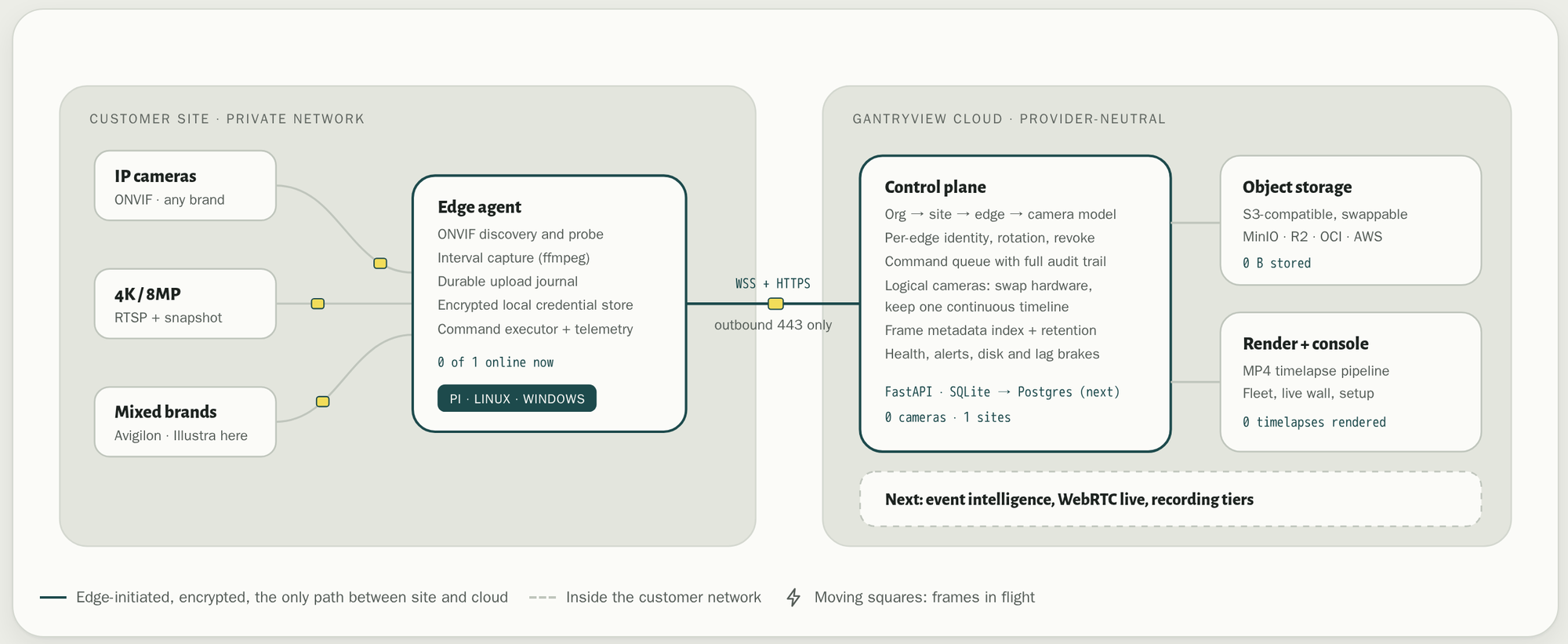
- inbound ports opened on a site's network: edge agents dial out over 443 to the cloud
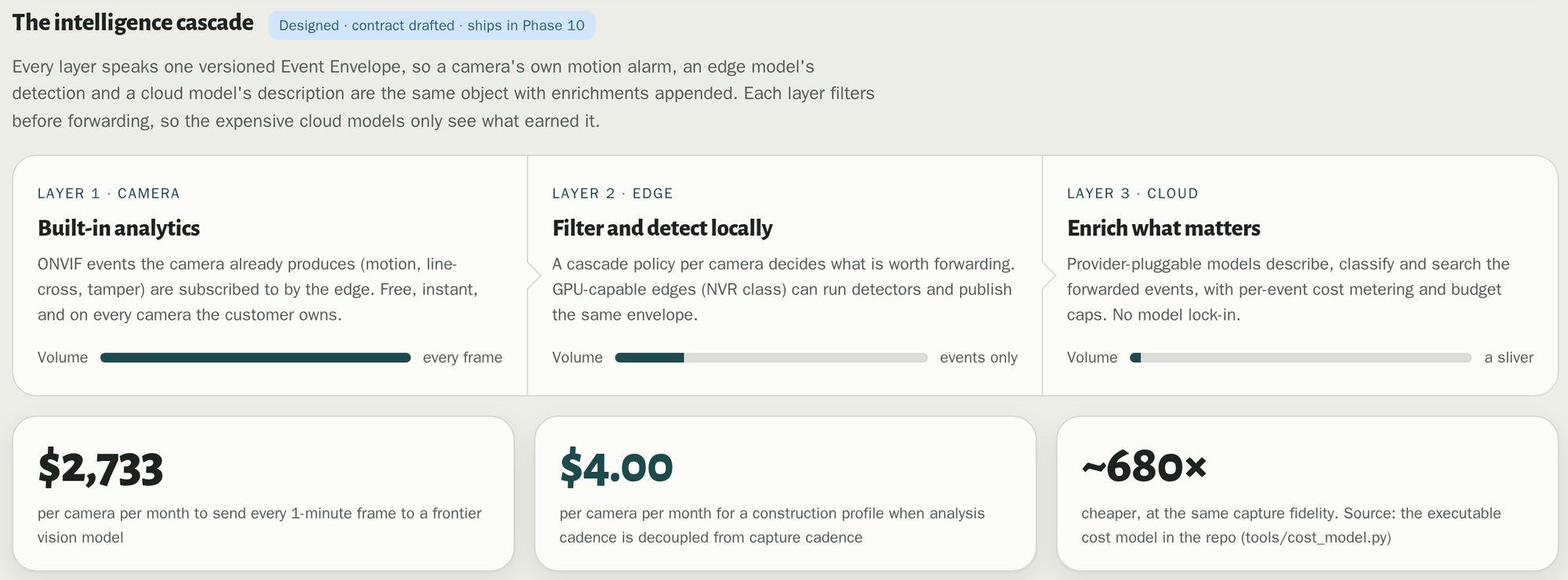
- Camera → edge → cloud
- the detection cascade being wired up now: each layer filters before forwarding, all in one versioned event envelope
- $4 vs $2,733
- modelled AI cost per camera-month for a construction site: filtered events versus every frame sent to a frontier vision model
- 172 of 172
- frames delivered after a storage outage test: the edge buffers in a durable queue, with no loss and no duplicates
GantryView is an edge-first video platform for organizations with IP cameras spread across many sites, built on the cameras they already own. It began as IP Timelapse; a redesign in November 2026 gave it its name, its own look and a platform page that draws the architecture with live counts.
At each site, a containerized edge agent on a small Linux or Windows machine connects to ONVIF-compatible cameras of any brand, captures frames over RTSP or snapshot at a set interval, and holds them in a durable upload journal until object storage confirms them. The edge only dials out, so nothing is opened on the site’s network. Camera passwords are encrypted in the cloud and provisioned once into an encrypted store on the edge; they never travel in a queued command. Every edge has its own identity that can be rotated or revoked, and every command is audited.
The cloud console shows the whole fleet: health, a live wall of the latest frames, and timelapses rendered with ffmpeg from weeks of frames, in standard JPEG and MP4 that stay the owner’s to download. A camera is a logical assignment to an edge, so replacing the hardware keeps one continuous timeline.
The platform is built to drive cascading AI detection, and that layer is being wired up now. A camera’s own ONVIF events (motion, line-cross, tamper) come first; the edge filters them, and GPU-class edges can run their own detectors; only what earns it reaches cloud vision models, all as one versioned event envelope with per-event cost metering. In the cost model, analysing filtered events instead of every frame takes a construction site from $2,733 to $4 per camera-month.
Feedback is welcome from teams who run camera fleets: which detections would matter most on your sites?